Why Understanding Heating Element Failure Is Critical for Your Plant’s Productivity
In an industrial setting, a single heater failure can halt an entire production line. While these components are designed for durability, they are often subjected to extreme stresses that lead to premature burnout. At DarwinHeat, we believe that 90% of heater failures are avoidable with the right selection and maintenance.

Mineral Scale Buildup Acts as a Silent Insulator
The most frequent cause of failure in liquid immersion applications is scaling. When minerals in water or heavy oils “bake” onto the heating element sheath, they create a thick insulating layer.
- The Result: The heat generated by the resistance wire cannot escape into the liquid.
- The Failure: The internal temperature of the element skyrockets, eventually melting the magnesium oxide (MgO) insulation or cracking the metal sheath.
- Prevention: Implement a regular descaling schedule or utilize water treatment systems to minimize mineral deposits.
Dry Firing Causes Catastrophic Instant Failure
“Dry firing” occurs when an immersion heater is energized while not fully submerged in liquid. This is the “nightmare scenario” for any industrial process.
- The Result: Without liquid to carry the heat away, the sheath temperature can exceed 1000°F within seconds.
- The Failure: The metal sheath glows red and either “bleeds” (melts) or bursts, leading to an immediate open circuit and potential safety hazards.
- Prevention: Always install low-liquid-level cut-off switches and ensure they are integrated into your safety interlock system.

Contamination and Moisture Ingress Lead to Internal Shorts
Heating elements are hygroscopic, meaning the MgO insulation inside acts like a sponge for moisture, especially during periods of downtime.
- The Result: If moisture enters the terminal end of the heater, it creates a conductive path between the heating wire and the outer sheath.
- The Failure: Upon startup, the current arcs through the moisture, causing a short circuit that trips the breaker and destroys the internal wiring.
- Prevention: Use IP65-rated moisture-resistant terminal boxes and perform a “Megger” test (insulation resistance) before energizing any heater that has been idle.
Excessive Watt Density Strains Material Limits
Every application has a maximum “Surface Load” or Watt Density. If you attempt to force too much power through a small surface area, you are inviting failure.
- The Result: The thermal stress causes the metal to expand and contract violently during every cycle.
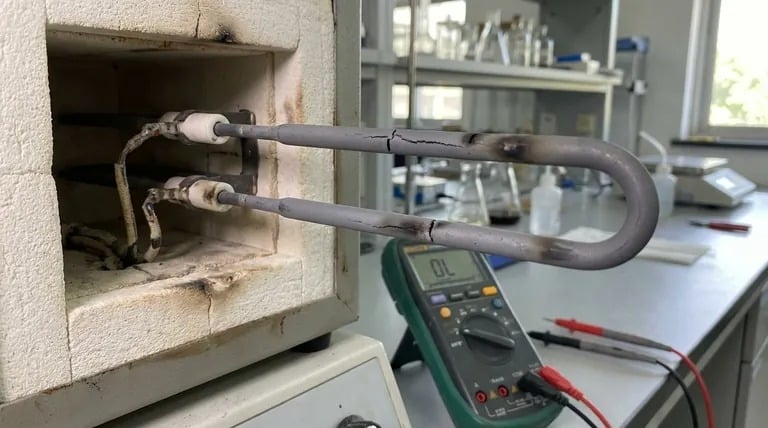
- The Failure: This leads to “material fatigue,” where the sheath becomes brittle and develops microscopic cracks, eventually leading to oxidation and burnout.
- Prevention: Ensure your heater is correctly sized for the medium (e.g., lower watt density for oil, higher for water).
Corrosive Environments Degrade the Outer Sheath
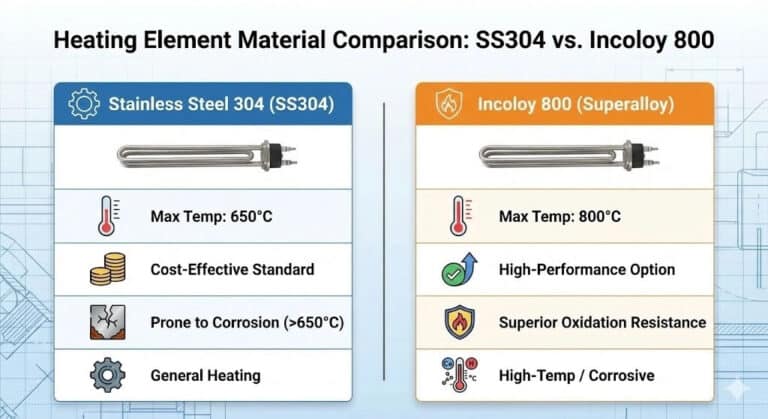
Not all stainless steels are created equal. Using 304 Stainless Steel in a high-chloride or acidic environment will lead to rapid chemical attack.
- The Result: Pitting and stress corrosion cracking eat away at the “skin” of the heater.
- The Failure: Once the sheath is breached, the internal insulation is exposed to the process fluid, causing instant electrical failure.
- Prevention: Match your sheath material to the chemistry of your fluid. Upgrading to Incoloy 800 or 316L Stainless Steel is often a cost-effective way to triple your heater’s lifespan.
Do You Have a Heater That Keeps Failing?
If you are experiencing recurring failures, it’s a sign of an application mismatch. DarwinHeat’s engineering team specializes in failure analysis. We can help you re-spec your heating elements with the correct materials and watt densities to ensure they last.